
Learn how low-volume injection molding supports small-batch production with cost-effective tooling, DFM tips, material options, and industry applications.
Introduction
Injection molding is widely used to manufacture plastic parts with dimensional repeatability, high-quality surface finishes, and a wide range of material options.
However, conventional injection molding is generally optimized for high-volume production, and steel molds are often too expensive for small quantities. If the design is still evolving or was previously prototyped using 3D printing, it may require a DFM review and further modifications before the mold is made.
Low-volume injection molding offers a practical way to produce functional, end-use plastic parts in smaller batches. With tooling and production methods suited to limited volumes, companies can manage tooling costs and inventory exposure while maintaining the quality and flexibility of injection-molded production.
What Is Low-Volume Injection Molding?
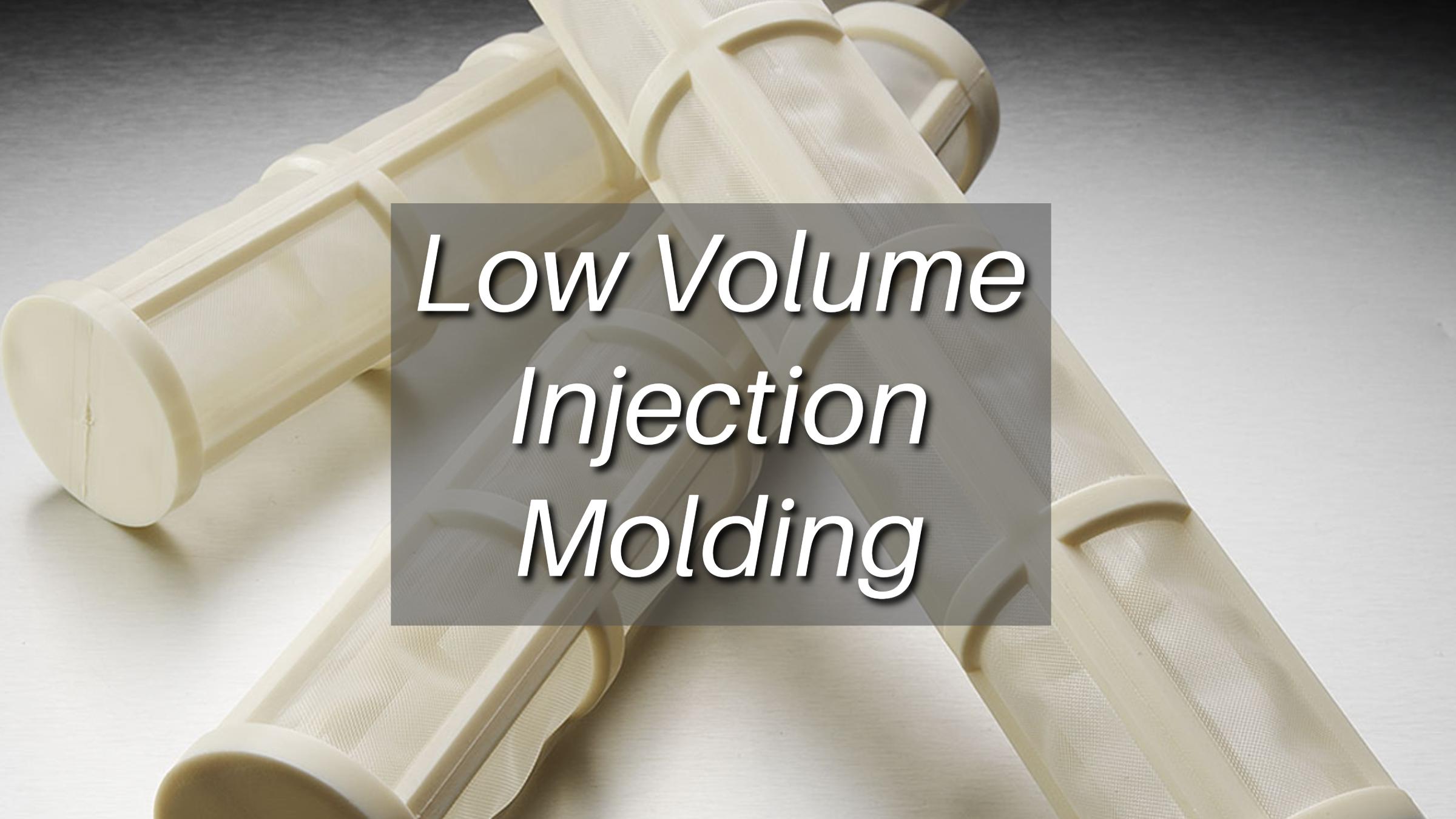
Low-volume injection molding generally refers to producing functional, end-use plastic parts in limited quantities, often ranging from around 100 to 10,000 parts depending on the project and manufacturer.
It uses the same basic injection molding process as conventional production, but the tooling strategy and production planning are adjusted to suit smaller or less predictable demand.
Depending on the required volume and part specifications, manufacturers may use aluminum tooling, single-cavity or low-cavity molds. These approaches help align tooling investment and production capacity with project requirements, while allowing businesses to produce injection-molded parts without committing to a large-scale production setup upfront.
Why Do You Need Low-Volume Injection Molding?
The need for low-volume injection molding depends on a product’s development stage, expected demand, and production requirements, particularly when production quantities are limited, demand is uncertain, or supply needs may change over time.
Understanding these scenarios can help you determine whether low-volume injection molding is appropriate for your project and when it may be worth considering alternatives or scaling up to higher-volume production.
The following are four common situations in which low-volume injection molding can be a suitable manufacturing option:
Part Performance and Assembly Validation
Market Testing and Initial Production
Low-Demand and Multi-SKU Production
Supply Gaps and Demand Fluctuations
The table below summarizes the product stage, the limitations of high-volume production, and how low-volume injection molding can address the needs of each scenario.
Scenario | Product stage | Why high-volume production may not be suitable | How low-volume injection molding helps |
|---|---|---|---|
Part Performance and Assembly Validation | The product is in the engineering validation stage and requires parts that closely represent the final molded product. | The design or material may still require changes, while a large production run could create unnecessary tooling, inventory, and modification costs. | It provides production-grade parts in limited quantities for functional testing, beta testing, certification, first-article inspection, and design comparison. |
Market Testing and Initial Production | The product is approaching commercialization, but market demand and future order volumes are not yet certain. | Investing in mass-production tooling and large inventories too early may result in excess or obsolete stock if demand changes. | It supports early sales and market feedback while allowing the company to delay large-scale tooling and production until demand is clearer. |
Low-Demand and Multi-SKU Production | The product has consistently limited demand, or total demand is divided across multiple models, colors, sizes, or configurations. | Producing every SKU in large quantities can increase excess inventory, storage costs, tied-up capital, and obsolescence risk. | It enables smaller batches based on actual demand and can serve as a practical long-term production method for specialized or multi-SKU products. |
Supply Gaps and Demand Fluctuations | The product already has an established production route, but short-term demand or supply conditions have changed. | Expanding or changing the regular production route may take too long when the shortage is temporary or additional demand is uncertain. | It provides a flexible backup or bridge supply, helping maintain part availability and reduce stockout risks while the normal supply route is restored. |
Tooling for Low-Volume Injection Molding
For low-volume projects, tooling should match the required quantity, part design, material, surface requirements, and future production plans. Key considerations include:
Mold material: Aluminum molds can help reduce tooling cost and lead time for limited production runs. Steel molds may be more appropriate for repeated orders, higher volumes, or longer tool life.
Cavity count and tooling complexity: Single-cavity or low-cavity molds are often suitable for small or uncertain quantities. Multi-cavity molds or additional tooling features may be considered when part geometry or future demand requires them, but they will increase tooling cost and complexity.
Tool life and quality requirements: Tool life should match the expected production volume and material. DFM review, T1 sampling, and first-article inspection (FAI) help verify that the selected tooling can consistently meet the required dimensional, appearance, and functional standards.
DFM Tips for Low-Volume Injection Molding
A well-designed part can help reduce tooling costs, avoid unnecessary mold modifications, and improve production reliability in low-volume injection molding. Because low-volume projects often prioritize shorter lead times and controlled upfront costs, identifying potential design issues before tooling begins is especially important.
Wall Thickness, Ribs, and Bosses
Wall thickness and supporting features have a direct impact on how plastic flows and cools inside the mold. Poorly designed transitions or overly thick sections can increase the risk of molding defects and dimensional problems.
Wall thickness consistency: Keep wall sections as uniform as practical. Significant variations in thickness can lead to uneven cooling, sink marks, voids, warpage, or incomplete filling.
Thick-to-thin transitions: Avoid abrupt changes between thick and thin sections. Gradual transitions help maintain more consistent material flow and cooling.
Ribs: Ribs can add stiffness without significantly increasing overall part weight, but overly thick ribs may create sink marks on the opposite surface. Their geometry should be balanced with the surrounding wall thickness.
Bosses: Bosses used for screws, fasteners, or assembly should provide sufficient strength without creating unnecessarily thick sections that are difficult to cool uniformly.
Draft, Undercuts, and Part Ejection
The way a part is designed relative to the mold opening direction determines how easily it can be removed from the mold. Features that make ejection difficult can require more complex tooling or lead to damage during production.
Draft angles: Surfaces parallel to the mold opening direction generally need sufficient draft to help the part release from the mold. Insufficient draft can cause sticking, drag marks, deformation, or difficulty during ejection.
Undercuts: Features that cannot be released directly along the mold opening direction may require slides, lifters, or other mechanisms. These features can increase mold complexity, cost, and maintenance requirements.
Deep pockets and narrow cores: Deep or narrow features can make machining, cooling, venting, and part ejection more challenging. They should be reviewed carefully during the DFM process.
Part ejection: Ejector locations and the forces required to remove the part can affect both part geometry and appearance. Large or delicate surfaces may require careful planning to avoid visible ejector marks or deformation.
Parting Lines, Surface Finish, and Dimensional Stability
Some design decisions affect not only whether a part can be molded, but also its appearance, dimensions, and functional performance. These requirements should be considered together before the mold design is finalized.
Parting lines: The parting line should be positioned where it has minimal impact on appearance, sealing surfaces, or critical assembly areas. Its location can also affect how the mold is constructed and how the part is ejected.
Gate location: Gate placement influences how molten plastic fills the cavity. An unsuitable location can contribute to visible gate marks, weld lines, flow marks, air traps, or incomplete filling.
Surface finish: Surface texture, polishing, and other finish requirements can affect mold machining and part ejection. Textured surfaces may also require additional draft to release cleanly from the mold.
Shrinkage and warpage: Plastic parts shrink as they cool, and uneven cooling or material distribution can cause dimensional changes and warpage. The material, part geometry, and mold design all need to be considered when defining critical dimensions.
Critical tolerances: Not every dimension needs the same level of precision. Applying unnecessarily tight tolerances can increase tooling, production, and inspection costs. Identify the dimensions that are genuinely critical to fit, function, or assembly.
Still unsure whether your design is ready for low-volume injection molding?
Get free DFM feedback from our engineering team to identify potential design issues.
Materials for Low-Volume Injection Molding
Low-volume injection molding can be used with a wide range of thermoplastics, from common materials such as ABS and PP to engineering-grade resins such as PC, nylon, and PEEK.
The table below summarizes some commonly used materials:
Material | Key Characteristics / Typical Uses |
|---|---|
ABS | Good impact resistance, strength, and dimensional stability. Common for housings, enclosures, and prototypes. |
Polypropylene (PP) | Lightweight, flexible, and highly resistant to moisture and many chemicals. Common for containers, living hinges, and general-purpose parts. |
Polyethylene (PE) | Good chemical and moisture resistance with good toughness. Available in different grades for a range of applications. |
Polycarbonate (PC) | High impact strength and good heat resistance. Available in transparent grades for applications requiring optical clarity. |
Nylon (PA) | High strength, toughness, wear resistance, and heat resistance. Often used for functional and mechanically loaded parts. |
POM (Acetal) | Low friction, good stiffness, dimensional stability, and wear resistance. Suitable for gears, bushings, and other moving components. |
Polybutylene Terephthalate (PBT) | Good electrical insulation, chemical resistance, and dimensional stability. Common in automotive and electrical components. |
PMMA (Acrylic) | Excellent optical clarity, UV resistance, and surface appearance. Used for transparent covers, lenses, and display components. |
TPE / TPU | Flexible, rubber-like materials with good elasticity. Used for grips, seals, gaskets, and soft-touch components. |
PEEK | Excellent mechanical strength, chemical resistance, and high-temperature performance. Used for demanding applications where higher material performance is required. |
Applications of Low-Volume Injection Molding
From medical devices and consumer products to electronics, automotive components, and industrial equipment, low-volume injection molding supports a wide range of specialized applications.
Medical Devices
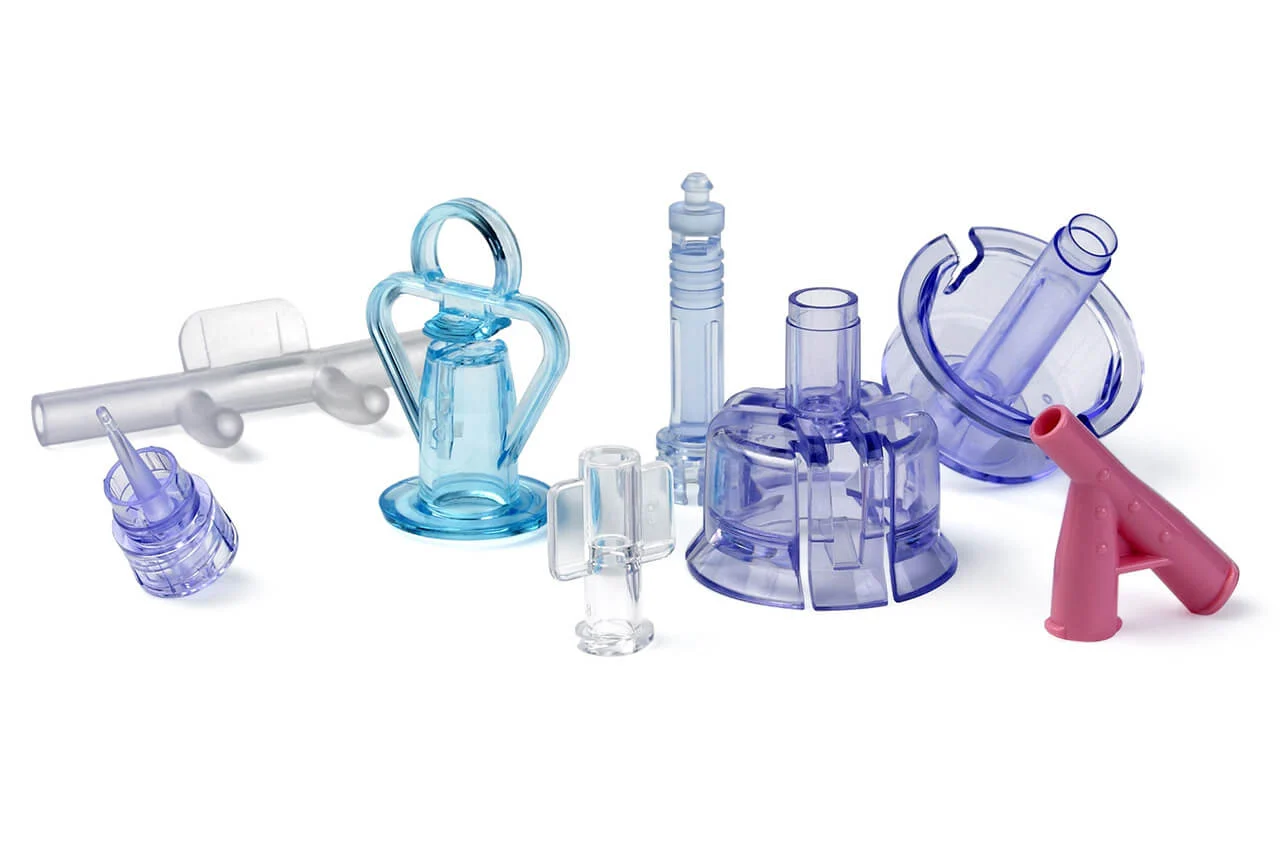
Low-volume injection molding can be used to produce medical components for functional testing, design verification, validation, pilot builds, and other development activities. Applications may include syringe bodies and plungers for drug delivery systems, customized inhaler components, fluidic cartridges, and housings for diagnostic devices.
It can also support small-batch production of specialized medical components for specific surgical applications or clinical requirements. For products intended for clinical use or clinical trials, the materials, manufacturing process, and quality controls must meet the applicable regulatory requirements.
Consumer Products
Low-volume injection molding is well suited to niche consumer products and market-entry phases where demand does not yet justify high-volume tooling. Typical applications include limited-edition color variations, customized ergonomic handles, personalized plastic accessories, specialized drinkware, and other household products.
It allows brands to evaluate market response and product performance without committing to high minimum order quantities or full-scale production tooling.
Electronics
For electronic hardware, low-volume injection molding can be used to produce production-intent housings, bezels, and internal chassis for design verification and production validation testing. Common applications include wearable and smartwatch housings, IoT sensor enclosures, handheld terminal casings, audio device frames, and smart home control panels.
These molded parts allow manufacturers to evaluate dimensional fit, assembly, appearance, and durability before committing to larger production volumes.
Automotive and EV Parts

The automotive industry relies on functional testing and validation when qualifying new vehicle designs and components. Low-volume injection molding allows automakers and Tier-1 suppliers to produce functional test parts for dimensional fit, assembly, material performance, and other validation activities before final production tooling is completed.
It can also serve as bridge tooling for pre-series vehicle builds, limited-production vehicles, aftermarket performance parts, and legacy replacement components. In electric vehicle development, short-run molding may be used for selected battery-module covers, cable-routing brackets, charging-interface components, and other non-volume parts during design iterations.
Robotics and Industrial Components
Many industrial equipment programs follow a high-mix, low-volume model. In these cases, low-volume injection molding provides a practical way to produce parts for engineering evaluation, field testing, and limited end-use production.
Typical applications include protective robotic joint covers, end-of-arm tooling components, specialized brackets, control handles, sensor enclosures, and other plastic parts used in industrial machinery and automation systems.
Conclusion
Low-volume injection molding is a practical solution for producing functional plastic parts in small batches, supporting applications such as product validation, market testing, and specialized production without requiring immediate investment in high-volume tooling.
Choosing suitable tooling, materials, and part designs, along with early DFM review, helps reduce production risks and ensure that molded parts meet project requirements. Evaluate your production volume, design, and quality needs to determine whether low-volume injection molding is right for your project.
Special offer: Get 10% off your first order when you sign up as a new customer.
FAQs
What Is Low-Volume Injection Molding?
Low-volume injection molding generally refers to producing around 100 to 10,000 functional, end-use plastic parts, depending on the project and manufacturer. It uses the same basic injection molding process as conventional production but often relies on cost-effective tooling, such as aluminum molds or single-cavity designs, to suit smaller production runs and uncertain demand.
What Is a T1 Sample?
A T1 sample is the first part produced during an initial injection mold trial. It is used to evaluate the part's dimensions, appearance, fit, and function before production approval. T1 sampling helps identify potential tooling or molding issues and determine whether adjustments are needed before moving forward.
What Are the Different Types of Injection Molding?
Injection molding can be classified by the material, molding process, or part structure. Common types include thermoplastic injection molding, insert molding, overmolding, two-shot molding, gas-assisted injection molding, and liquid silicone injection molding.
How Much Does Low-Volume Injection Molding Cost?
The cost depends on several factors, including mold design, tooling material, part size and complexity, plastic material, production quantity, surface finish, secondary operations, and quality requirements. Although the per-part cost may be higher than in high-volume production, low-volume molding can reduce the initial tooling investment and make small-batch production more economical.
How Do I Choose a Low-Volume Injection Molding Supplier?
When choosing a supplier, consider its experience with similar parts, tooling capabilities, material selection, quality-control processes, production capacity, and communication during the sampling and validation stages. It is also useful to confirm whether the supplier can support design review, mold trials, T1 sampling, secondary operations, and repeat production.